Leave A Message
If you are interested in our products and want to know more details,please leave a message here,we will reply you as soon as we can.
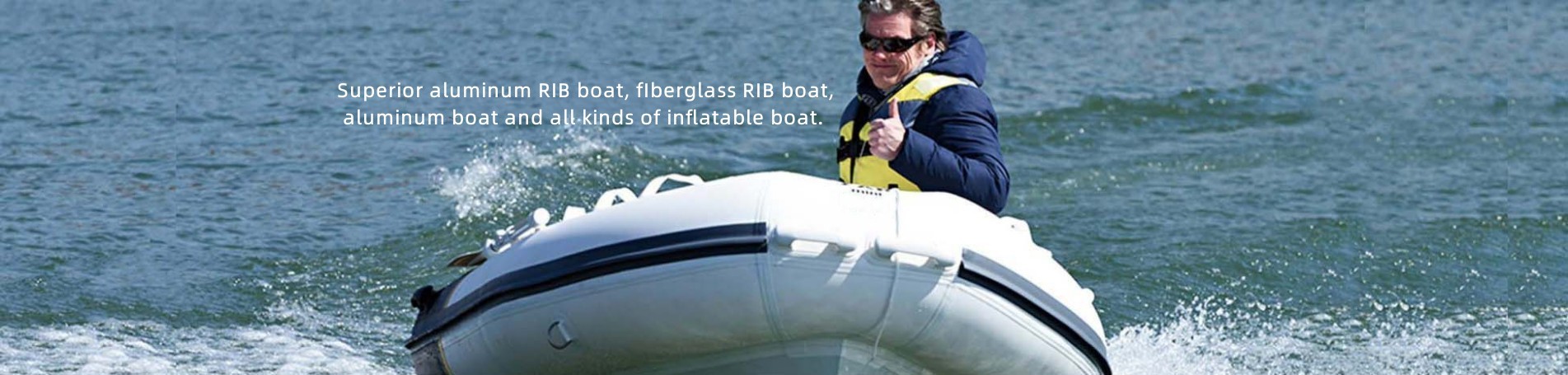
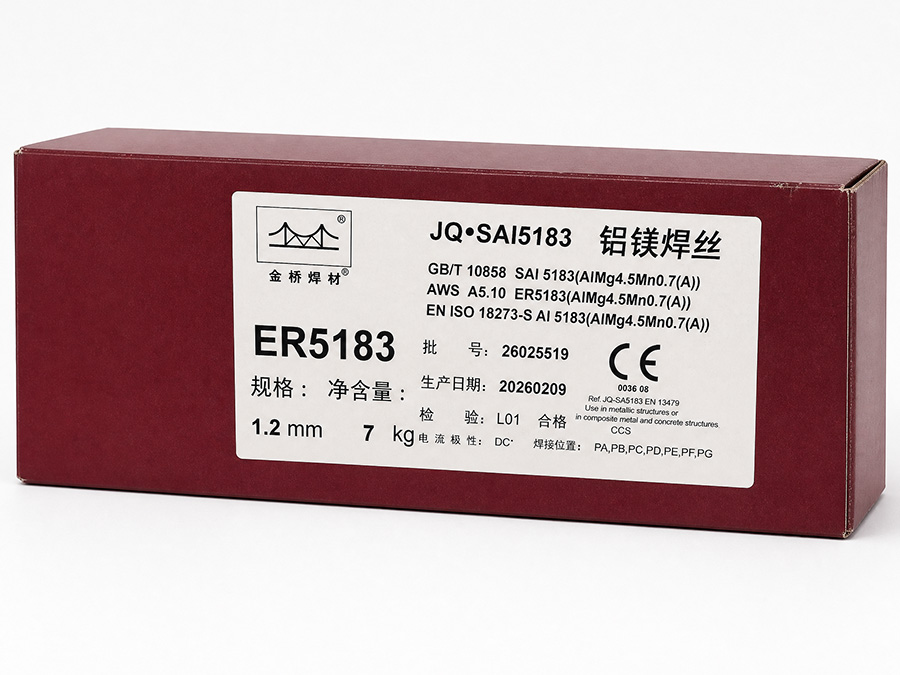
The structural characteristics of aluminum ribbed boats determine the core contradiction of their welding process: the criss crossing ribs form a large number of T-joints and fillet welds with the outer panels of the boat, with concentrated heat input and high restraint. On the other hand, aluminum alloys have high thermal conductivity and a coefficient of linear expansion about twice that of steel, and are much more sensitive to welding deformation and porosity than steel structures. In this context, welding wire is no longer just a "filler metal", but a key variable that matches with the base material, coordinates with process parameters, and interacts with structural constraints. 5183 and 5356 are the main filling materials for 5083 series ship aluminum plates. The reasonable selection and process adaptation of the two directly determine the strength level, seawater corrosion resistance life, and construction accuracy of the welded joints of the rib ship.
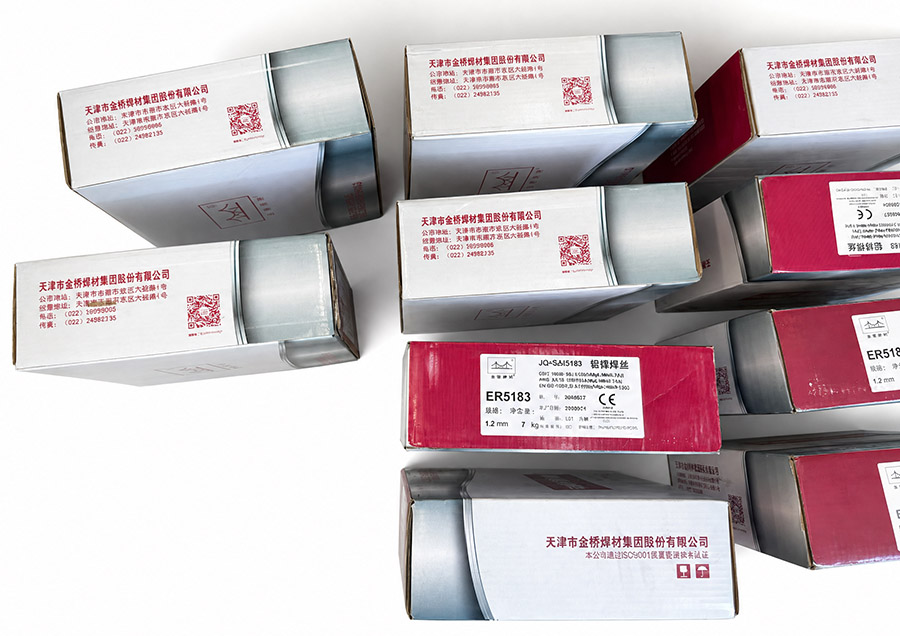
Solid core wire specification
| Alloy | 5183 |
| Grade | WC |
| Wire diameter | 0.8 - 1.0 - 1.2 - 1.6 mm |
| Wire spool size | D300(9kg), D270 (7kg), D200 (2kg), D100 (0.5kg) |
| Packaging | Wire spool, straight wire, coil wire, barrel |
| Features | 5% magnesium content, strong versatility, high strength, and good color after welding. |
| Recommended soldering method | Gas Shield Argon 100% |
| Welding Position | All positions for butt welding except vertical downwards (PA,PF,PC,PE) |
Chemical Composition
| Alloy | Si | Fe | Cu | Mn | Mg | Cr | Zn | Ti | Ai |
| 5183 | ≤0.4 | ≤0.4 | ≤0.10 | 0.5-1.0 | 4.3-5.2 | ≤0.25 | ≤0.25 | ≤0.15 | Remainder |
The outer hull and main ribs of aluminum ribbed boats are generally made of 5083 aluminum magnesium alloy. This alloy cannot be strengthened by heat treatment and relies on solid solution strengthening and work hardening of Mg to obtain strength. Welding thermal cycles inevitably cause softening of the heat affected zone, and the burning of Mg elements in the melt pool will weaken the number of strengthening phases in the weld. Therefore, the Mg content and alloying design of the filler wire are the first line of defense to compensate for heat affected zone losses and maintain joint strength. The nominal Mg content of 5356 is 4.5% -5.5%, and the as welded tensile strength is about 270-310 MPa, which matches well with the 5083 base material. When MIG welding 5083, the joint strength can reach about 85% of the base material. Its resistance to seawater corrosion meets the service requirements of the general structure of the ship, and the color matching after anodizing is good, suitable for superstructure and exposed areas. However, when the key joints of the rib ship involve large plate thickness, high restraint angle welds, or low-temperature service conditions, the strength margin and crack resistance of 5356 appear insufficient. 5183 has a Mg content similar to 5356 (about 4.9%), but the Mn content is increased to 0.5% -1.0%. This compositional adjustment results in finer grain structure and higher weld strength of the weld metal under rapid solidification conditions. Lincoln Electric's comparative data clearly states that 5183 has "higher strength and superior salt water corrosion resistance compared to 5356" when welding universal shipbuilding base materials, and is specifically designed for "very high as welded strength" of high magnesium alloys such as 5083. The strong and tough reserve of 5183 provides more reliable redundancy for the full circumferential corner welds of the longitudinal perforation holes on the side of the rib ship, the connection nodes between the rib plate and the longitudinal truss, and the structural joints in low-temperature environments.
Typical Features
| Alloy | 5183 | 5356 |
| Melting range | 1075-1180°F | 1060-1175°F |
| Conductivity | 16-19Ω·m/mm2 | 29%lACS(O) 27%lACS(H18) |
| Density | 2.66g/mm2 | 2.66g/mm2 |
| Corrosion resistance | A(Gen)A(SCC) | A(Gen)A(SCC) |
| Thermal expansion coefficient (20℃~300℃) | 23.7×10¯⁶/K | 23.7×10¯⁶/K |
| Thermal conductivity (20℃) | 110-120W/m.k | 110-150W/m.k |
The process significance of wire selection must be realized on rib ships through welding parameters and operational strategies. The practice of MIG welding of 5083 aluminum alloy shows that under the conditions of grinding and preheating to 150 ℃, base current of 170-180 A, interlayer current of 210-230 A, and groove angle of 90 ° before welding, combined with symmetrical welding and high-purity argon gas protection, the lack of fusion and porosity can be significantly reduced, and the tensile performance of the joint can be improved by 57.6%. These parameters have benchmark reference value for both 5183 and 5356, but there are slight differences in their process windows: 5183 requires slightly less current at the same wire feeding speed, has stronger anti sagging ability of the weld bead, and has better operational tolerance in the vertical and upward welding positions of the rib corner weld. The protective gas must use pure argon (I1 grade), with a flow rate controlled at 15-20 L/min. It is strictly prohibited to introduce CO ₂ or mixed gases, otherwise it will damage the metallurgical purity of the aluminum magnesium weld and exacerbate the tendency of porosity. For typical rib fillet welds with 1.2 mm welding wire and 5-8 mm plate thickness, the reference parameters for 5356 are DCEP, 21-25 V, 160-220 A, and wire feed speed of 200-300 IPM. During actual welding, fine adjustments should be made based on the melt flow characteristics of 5183 to avoid excessive heat input leading to a wide heat affected zone and increased Mg burning.
The real difficulty in welding aluminum rib boats lies in the fact that the performance of the welding wire must be transformed into structural integrity through a reasonable welding sequence and deformation control strategy. The fillet weld between the ribs and the plate forms a closed or semi closed constraint frame inside the hull. If welding is carried out continuously from one end according to tradition, angular deformation and longitudinal shrinkage will quickly accumulate, leading to rib spacing deviation and plate instability. The shipyard practice and patented technology both point to the same principle: symmetrical welding, expanding from the middle to the periphery, and using a local slow welding method of "full welding on one side, spot welding on the other side for positioning, and repairing welding after the overall formation" for high constraint joints. In the specific operation of ribbed ships, the centerline of the hull should be taken as the reference, and the middle ribs should be symmetrically pushed towards the bow and stern. The fillet welds of each rib should be welded in sections or alternately skipped; Weld the joint at the intersection of the vertical and horizontal components first, and then weld the corner joint to release the welding stress. Constraint welding cannot be ignored: before the segmented closure, the welded rib frame is rigidly fixed to the tire frame, so that the 5183 or 5356 weld seam completes the main shrinkage in the constrained state, and then the constraint is released for overall assembly, which can effectively "lock" the welding deformation within a controllable range. There is a coupling relationship between these measures and the selection of welding wire - the higher high-temperature strength and crack resistance of 5183 make it have a lower risk of crystal cracking in strongly restrained fillet welds, while 5356 shows better economy in thin plate ribs or superstructure welds with well controlled deformation and moderate heat input.
Pores are the most stubborn defect in aluminum magnesium alloy MIG welding, especially fatal to the welds of watertight rib plates and side outer plates of ribbed ships. The sudden change in solubility of hydrogen in the aluminum melt pool is the fundamental source of porosity, while the oil, moisture, and base metal groove oxide film on the surface of the welding wire are the main carriers of hydrogen. Therefore, whether using 5183 or 5356, thoroughly cleaning the welding wire and groove area before welding, controlling the environmental humidity, and using high-purity protective gas are essential steps in the process discipline that cannot be compromised. At the parameter level, appropriately increasing the base current to increase the depth of fusion and the residence time of the melt pool is beneficial for bubble escape, but the interlayer temperature needs to be controlled within a reasonable range to avoid repeated overheating leading to intensified softening of the heat affected zone. For joints with large thickness or extremely high restraint in rib ships, ultrasonic vibration assisted MIG welding has been proven to significantly reduce porosity and stabilize tensile strength above 290 MPa, providing a process enhancement method for the application of 5183 on high demand rib nodes.
The selection of marine materials is never purely based on technical comparison, but on the unity of technical rationality and compliance with regulations. 5183 and 5356 have mature coverage in the certification systems of mainstream classification societies: Lincoln Electric's SuperGlaze 5183 is explicitly listed in the recognition lists of CCS, DNV-GL and other classification societies, ESAB's OK Autrod 5183 also holds DNV certification, and 5356, as a general marine aluminum magnesium welding wire, has long-term application records in ABS, LR, BV and other specifications. This means that in the construction of aluminum ribbed ships, the selection of welding wires can be differentiated according to the functional requirements of structural parts while meeting specifications: key joints between watertight bulkheads, side panels, and low-temperature areas are prioritized to use 5183 to obtain higher strength storage and seawater corrosion resistance margin; 5356 can be selected for areas with prominent color matching requirements for non watertight internal components, superstructure thin plates, while ensuring both service performance and process economy. Welding wire is the starting point of the aluminum rib ship welding chain, but it can only truly fulfill its alloy design performance commitment when it forms a systematic match with the base metal state, joint restraint, heat input strategy, and deformation control method.

 Qingdao Colton Yacht Co.,Ltd Factory address: Developed zone, Laixi District, Qingdao,China Office address: Baoli building,Jinshui road, Licang district, Qingdao,China
 +8615165275783
 sales@coltonyacht.com


 IPv6 network supported